
A true story about why we should take the risk… why doing nothing is the greatest risk.
My grandfather was 92 when he passed away.
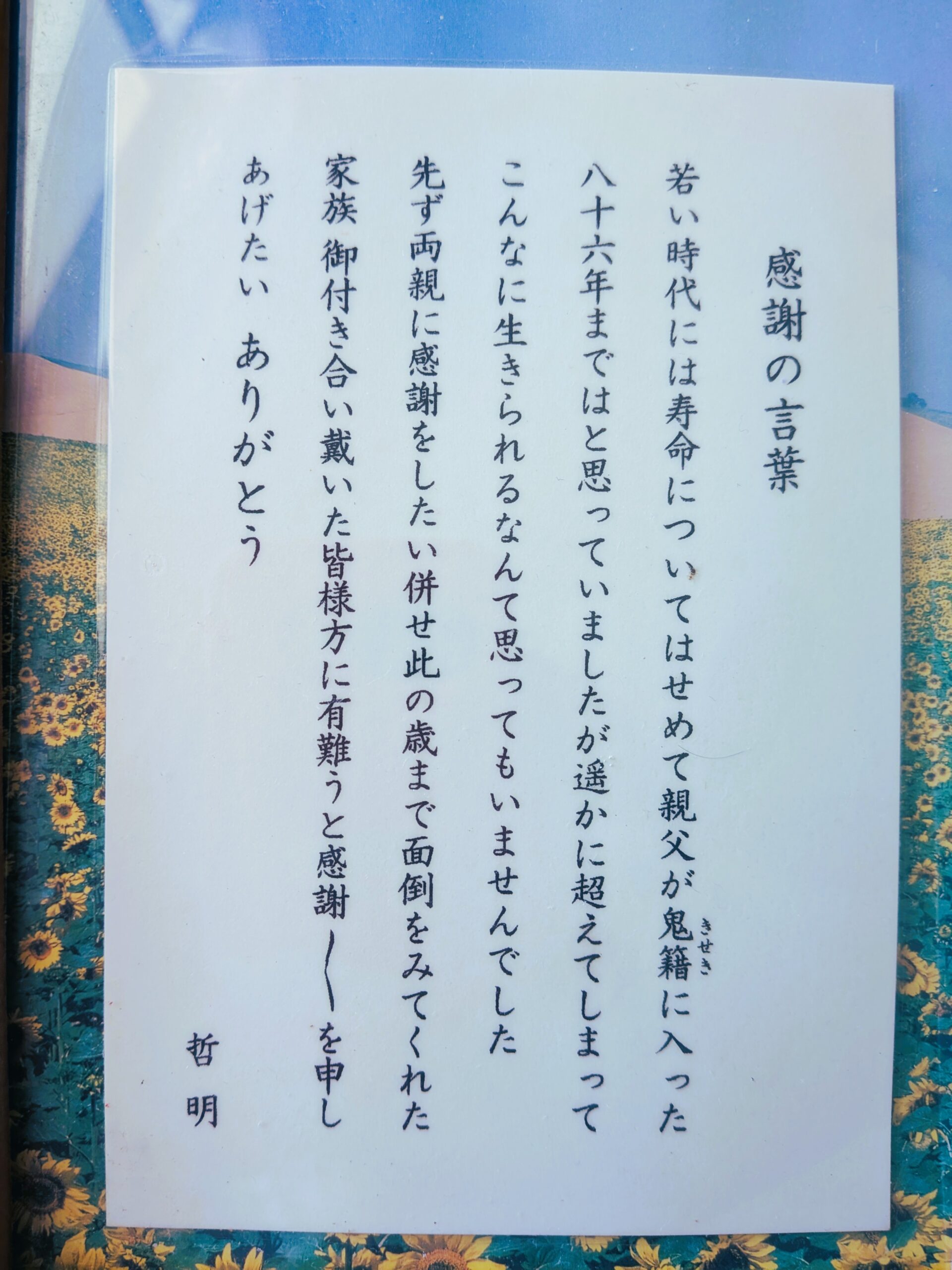
“To everyone who helped me live this long and to God, thank you, thank you”.
In the months leading up to his passing, he wrote his own epitaph full of gratitude for life, and it remains ingrained in my memory. The day of his funeral was tumultuous yet picturesque perfect, a paradox which reflected his life. I still remember it as if it were yesterday.
The sky is a clear blue, shatteringly cold. Peace emanates across the room in a Zen – like ambiance, shedding silent tears across the creaking wooden floorboards of this timeless temple. Outside, the bustling city of Tokyo is a constant chaos of motion, but here, within these 4 walls, one would not know whether it was 2018 or 1618. Nearby the monk sits serenely adorned in his robe, surrounded by drums, head bowed. As his granddaughter, I claim the front row seat; is that a tear I see breaking through the monk’s serene meditative expression?

My grandfather’s final words before he passed away.
In my grandfather’s heart, this temple was sacred ground. He had given so much of his life to this place. Our monk had deeply respected my grandfather, not only for his kindness, but for the story behind his life that set an example of greatness for so many. Inhaling deeply, the monk begins. “Hannyaaaa hannkyou…..” The monk’s chants reverberate surrender, a relinquishing of the corporeal into ether.
My grandfather’s story began when he was told that he could not pursue his dream to become a prosecutor, or perhaps it began even earlier, on that fateful day in his childhood when his little brother died from an illness that was completely treatable if only his parents had enough money to send for the doctor. Growing up during WW2 Japan carved jagged contours into a young person’s character, piercing arrows into the depths of their soul. Some could never be retrieved, hopes and dreams muddied by the domino-like devastation of war.
Yet this man was not one to shrink in sorrow. Instead of accepting defeat, he got creative. He fought back harder. Studying by the light of a firefly in a jar by evening and working whatever job he could by day, he did everything he possibly could to both keep food on the table for his family and continue working towards his dreams. You see, when he was 12, his teacher had come to his home to beg his mother to keep him in school, but with 7 younger sisters, it was unthinkable. His fate had been sealed – at 12, he became the paper boy, waking up in the cold before dawn each morning, overcoming his fear of darkness so that his family could eat.

Looking back over his life now, it is unfathomable to think that since the Taisho era into which my grandfather was born, Japan has seen the rise of two new emperors, and with it, the transformation of a nation’s entire way of being. When he was growing up, there was no TV, no ball point pen, no fax machine even….these things had not yet been invented. Household electricity was non-existent for the everyday Japanese, and therefore one of children’s favorite pastimes was to catch fireflies. Could you imagine kids today, outside catching fireflies so that they could study in the evenings?
At 16, he was called to enlist and sent to the military base at the foot of Mount Fuji. Patriotism in Japan was rife with self-sacrifice for the survival of the nation. I will never forget what he told me as we sat snug in the kotatsu one cold winter evening:
“Dying for our country in battle was considered a heroic act, almost an expectation. It was shameful to come home alive.” As the heater murmured in the quiet, he continued: “As I was walking out the door, only my mother whispered to me so as not to be overheard: ‘Tetsu, come home alive.”
Those words burn into my memory, reminding me of life’s fragility and unpredictability. There is nothing more powerful than story.
You might ask, what does all this have to do with entrepreneurship and financial education? Well, this is the remarkable story of a young man who overcame the tragic circumstances of his upbringing to become a successful businessman and entrepreneur.
This man, by sheer luck and wit, managed to come home alive. The war had finished unleashing the last of its devastation upon the world before he had completed his training, and he was able to make his way home, choosing his route carefully to escape confrontations with U.S. soldiers. In the flattened landscape of post WW2 Japan, he struggled to orient himself towards his own North Star.

Battered by the economic crises of war and seeking to give back meaningfully to his community, he entered the public service as a firefighter. Ten years of service in that profession ended rather abruptly the day he realized that despite his tireless work, his lack of formal education meant he would never be promoted. He would remain stuck in the same position for the rest of his life if he stayed. The rise of his younger subordinates into superior positions due to their higher education fueled his drive to start a business of his own in real estate. Entrepreneurship was nothing new to him; since childhood he had raised chickens to sell, started yakitori food stalls by night – anything to supplement his family’s income.
Working tirelessly night and day with a young family to support, he stubbornly pursued his vision. In a dim office with threadbare furniture and no funding, his real estate dream was born. The dream of a young, penniless man, shaped by the jagged contours of war, has now transformed into a living, breathing business of over 70 years. My grandfather always told me:
“When we are young, we work to invest in ourselves. During our middle years, we work to support our loved ones. And in our old age, we work to give back to our community, the source of all our riches.’“
Instead of succumbing to circumstances, he had the courage to confront the unknown.
The truth is, the journey to wealth begins with your character.
There is no ‘get rich quick’ scheme. Every successful business is focused on offering a service which will in some way enrich the lives of others. Businesses are about giving back, not about taking. We become wealthy both financially and spiritually through helping others. Practicing Zen Buddhism as a way of life teaches us to confront extremely challenging situations without labelling them as difficult. Zen teaches us to find the silence and stillness within the chaos of 21st century information overload, to ignore the hype, and instead, listen to our own intuition.

In every investment decision I’ve made, in every life choice at crucial crossroads, I have practised this simple Zen principle taught to me by my grandfather: stillness. He taught me to take calculated risks, to dream and to build, and to learn success through failure. I trust my own ability and I am open to growth opportunities, especially those which are painful and uncomfortable.
Many young people in the West today have become too complacent, too risk averse. But the truth is, we need adversity to grow. We need it the way our vegetable gardens need the sun. We need to water that garden which is our spirit. The brilliant young minds of today must flood themselves in the abundant garden of the stock market, crypto currency, real estate, and business ideas that will one day through their very own hard work transform into successful companies…take the road less travelled.
As far as building long-term wealth is concerned, cash is trash. Instead of stashing money in a savings account that is guaranteed to lose against fiat currency devaluation, we need to think about how young people can invest for tomorrow and feel hope for their future. The right investments will help them prosper financially as well as spiritually. And the more resources they have, the more they can help others.
My role is not to give young people specific investment or entrepreneurial advice; instead, it is to guide them through this tumultuous landscape. It is to help them understand what their options are and give them the tools they need to begin this journey of slowly compounding their wealth.
Always remember, there are people out there who need what only you can give. Everybody has something unique to give, a unique gift; together, we’re going to find out what that is. As Les Brown once said:
“Don’t leave this world with your dreams still in you.“